


Child Health
Introduction
In India, an estimated 26 millions of children are born every year. As per Census 2011, the share of children (0-6 years) accounts 13% of the total population in the Country. The child health programme under the National Health Mission (NHM) comprehensively integrates interventions that improve child survival and addresses factors contributing to infant and under-five mortality. It is now well recognized that child survival cannot be addressed in isolation as it is intricately linked to the health of the mother, which is further determined by her health and development as an adolescent. Therefore, the concept of Continuum of Care, that emphasizes on care during critical life stages in order to improve child survival, is being followed under the national programme. Another dimension of this approach is to ensure that critical services are made available at home, through community outreach and through health facilities at various levels (primary, first referral units, tertiary health care facilities). The newborn and child health are now the two important key pillars of the Reproductive, maternal, newborn, child, and adolescent health and Nutrition (RMNCAH+NA) strategic approach, 2013.
India has shown progress in Sample Registration System indicators:
| Indicator (SRS Reports) | 2014 | 2015 | 2016 | 2017 | 2018 | 2019 | 2020 | 2021 | 2022 |
|---|---|---|---|---|---|---|---|---|---|
| NMR | 26 | 25 | 24 | 23 | 23 | 22 | 20 | 19 | 19 |
| IMR | 39 | 37 | 34 | 33 | 32 | 30 | 28 | 27 | 26 |
| U5MR | 45 | 43 | 39 | 37 | 36 | 35 | 32 | 31 | 30 |
NMR-Neonatal Mortality Rate;
IMR-Infant Mortality Rate;
U5MR-Under 5 Mortality Rate;
SRS-Sample Registration System.
Child Health goals under National Health Policy (NHP-2017) and Sustainable Development Goal (SDG-2030)
National Health Policy (NHP-2017)
The Child Health programme under the Reproductive, maternal, newborn, child, adolescent health and Nutrition (RMNCAH+N) Reproductive, Maternal, Newborn, Child and Adolescent (RMNCH+A) Strategy of the National Health Mission (NHM) comprehensively integrates interventions that improve child health and nutrition status and addresses factors contributing to neonatal, infant, under-five mortality and malnutrition. The National Population Policy (NPP) 2000, the National Health Policy 2002, Twelfth Five Year Plan (2007-12), National Health Mission (NRHM – 2005 – 2017), Sustainable Development Goals (2016-2030) and New National Health Policy, 2017 have laid down the goals for child health.
Child Health Goals under Sustainable Development Goal (SDG-2030)
Goal 3.2: By 2030, end preventable deaths of newborn and children under 5 years of age, with all countries aiming to reduce neonatal mortality to at least as low as 12 per 1000 live births and under-5 mortality to at least as low as 25 per 1000 live births.
Status of Current Child Health Indicators with respect to NHP and SDG Target
| Indicator | Current Status | National Health Policy 2017 | SDG 2030 |
|---|---|---|---|
| Neonatal Mortality Rate (NMR) | 20 | 16 by 2025 | ≤12 |
| Infant Mortality Rate (IMR) | 28 | 28 by 2019 | – |
| Under-5 Mortality Rate (U5MR) | 32 | 23 by 2025 | ≤25 |
*Source: Sample Registration System 2020 Report of Registrar General of India
Causes of Neo-natal Mortality
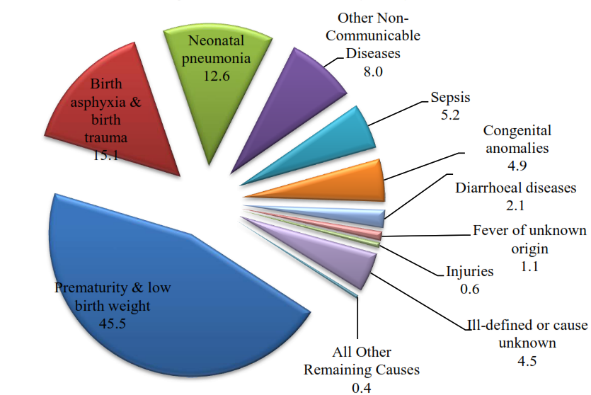
As per Cause of Death Statistics 2020-22 released by the Office of the Registrar General & Census Commissioner, India; major causes of new-born deaths in India are:Prematurity & low birth weight (44.7%) , Birth asphyxia & birth trauma (15.1%), Neonatal Pneumonia (10.1%), Sepsis (6.4%), Other non-communicable diseases (5.9%), Congenital anomalies (4.3%), Diarrhoeal diseases (0.9%), Fever of unknown origin (0.9%), Injuries (0.9%), Ill-defined or cause unknown (10.3%), and All Other Remaining Causes (0.5%).
*Source: SRS Cause of Death Statistics Report 2020-22
Causes of Infant Mortality
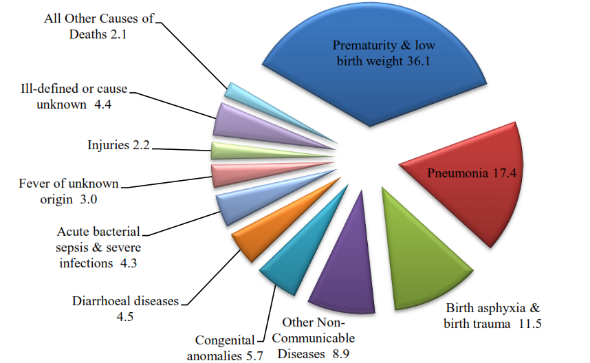
As per Cause of Death Statistics 2020-22 released by Office of the Registrar General & Census Commissioner, India; major causes of infant mortality in India are – Prematurity & low birth weight (31.6%), Pneumonia (16.2%), Birth asphyxia & birth trauma (10.2%), Other Non-Communicable Diseases (7.8%) Congenital anomalies (5.3%), Sepsis (4.1%), Fever of unknown origin (3.9%), Diarrhoeal diseases (3.6%), Injuries (2.8%), Ill-defined or cause unknown (11.5%), and All Other Causes of deaths (2.8%).
*Source: SRS Cause of Death Statistics Report 2020-22
Causes of Child Mortality in India
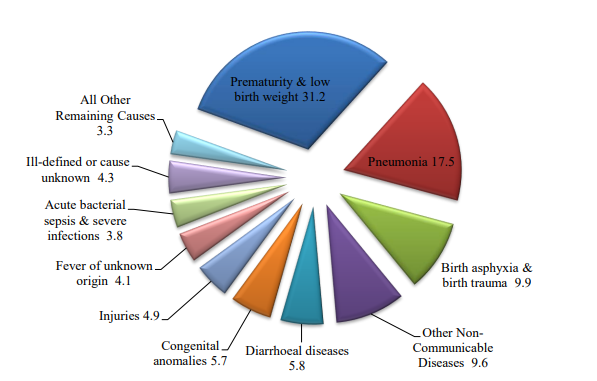
As per Cause of Death Statistics 2020-22 released by Office of the Registrar General & Census Commissioner, India; major causes of child mortality in India are – Prematurity & low birth weight (28.7%), Pneumonia (16.2%), Birth asphyxia & birth trauma (9.2%), Other non-communicable diseases (8.6%), Congenital anomalies (5.3%), Injuries (4.6%), Fever of unknown origin (4.6%), Diarrhoeal diseases (4.1%), Sepsis (3.7%), Ill-defined or cause unknown (11.5%), and All other remaining causes (3.5%).
*Source: SRS Cause of Death Statistics Report 2020-22
Thrust area under Child Health programme
Thrust Area 1: Neonatal and Child Health
- Essential newborn care at every ‘delivery’ point at time of birth
- Facility Based Newborn Care (FBNC) at FRUs, District Hospitals and Medical College level
- Home Based Newborn Care (HBNC) and Home Based Care for Young Child (HBYC) Programme
- FIMNCI and IMNCI
- National Newborn Week
- India New Born Action Plan
Thrust Area 2: Child Health (Management of Childhood Diarrhoeal Diseases & Acute Respiratory Infections)
- Strengthening of Paediatric Care at district and sub-district level
- STOP Diarrhoea Campaign for promoting use of ORS and Zinc and for reducing morbidity and mortality due to childhood diarrhoea
- Social Awareness and Actions to Neutralize Pneumonia Successfully (SAANS) initiative for reduction of childhood morbidity and mortality due to Pneumonia
- Child Death Review (CDR) Mechanism
Thrust Area 3: Comprehensive care to improve the overall quality of life of children
- Rastriya Bal Swasthya Karyakram (RBSK)